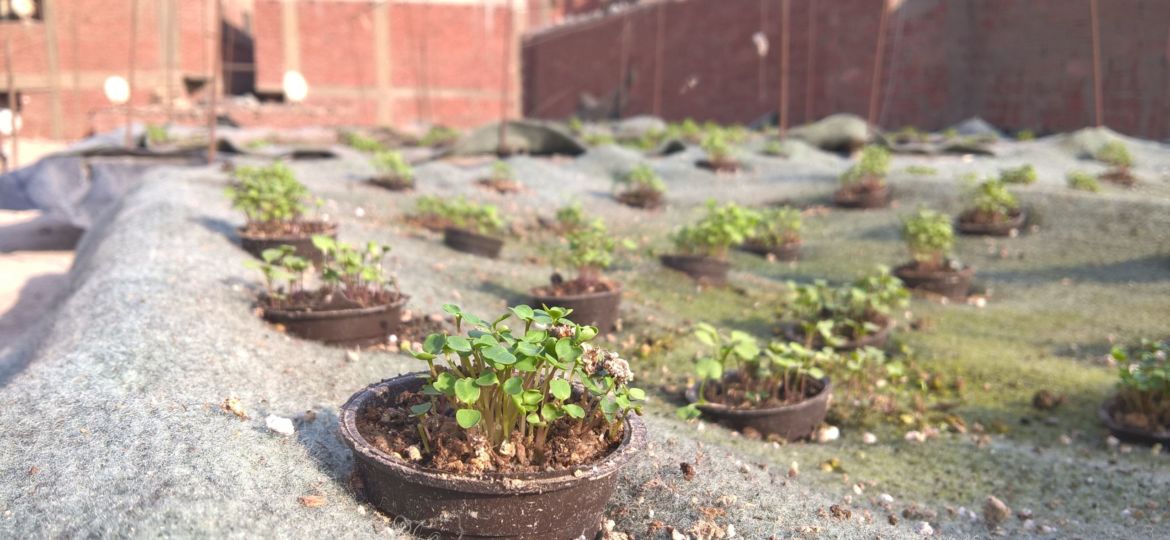
Two brothers in Cairo were inspired by an ancient method of irrigation to achieve food security and self-sufficiency for low-income groups. Last year, Sherif and Tarek Hosni launched Schaduf, a rooftop farming foundation designed to empower and support low-income people. The Schaduf is an ancient method of irrigation that is still used by farmers in many countries today. It is a machine that raises water into agricultural irrigation canals. The Schaduf Foundation works to promote soilless hydroponics on rooftops in urban areas of Cairo.
The foundation works with low-income Egyptians living in Maadi, Cairo and has developed a reputation for promoting social good through simple innovation, which landed it a place among the 14 finalists of the MIT Best Arab Business Plan competition last year.
From Cairo to Louisiana and then to Cairo
Sherif and Tarek Hosny volunteered in New Orleans after Hurricane Katrina in 2010, where they witnessed hydroponic farming. This technique relies on dissolving mineral nutrients in water to grow plants in containers without soil. Tariq explains, “It was amazing that she could grow crops and raise fish in the same environment… and once we saw that, we couldn’t ignore it.”
Tarek and Sherif, who both hold engineering degrees, jointly developed the Schaduf Foundation to enable Egyptians to use unused spaces to improve their living conditions. But although they are not farmers by training, their backgrounds in business and engineering enabled them to develop the vision that underpins Schaduf and the business model that it has adopted, says Sharif.
Schaduf uses proven methods to simplify rooftop farming to make the greatest possible impact on poorer segments of the population. When modifying the technology to adapt to the Egyptian reality, Sharif noted that the biggest obstacle is changing the mentality of these segments, noting that “the idea that you can farm rooftops is a strange idea from the local culture so this was kind of a challenge. But after we had examples, it became The whole thing is easier.”
Success is Simple
Schaduf has a simple business model, beginning to sell rooftop structures to low-income families with easy-to-pay loans and contract to build small rooftop farms with a manufacturer that installs the facilities in less than a day. A portion of the sales of the monthly crop goes to repay the loan which the farmers can pay back within one year. In order to make sure that the crops meet the existing demand, Schaduf carefully monitors the local markets every season and recommends the most suitable seeds for the best and most profitable crops. Families keep about 10% of the crops for personal use, and the remainder is sold by “Shaduf” to local markets, giving profits to farmers.
In general, says Tarek, donations are not enough to boost economic development. “You need to get people to want the product.” He explains that by incentivizing agriculture through loans, Schaduf will be able to increase the efficiency of rooftop farming away from the efforts of the government and NGOs based on grants. When farmers have an interest in the success of their farms, this will motivate them to work towards generating returns for themselves, their families and for “Shaduf” that gives customers a sense of independence, dignity and personal achievement, unlike traditional support programs that usually leave customers with a feeling of dependence and impulsiveness.
Schaduf has tried other rooftop farming techniques but finds that simple measures work best. The focus on simplicity has allowed the organization to bypass some of the trust issues that typically occur between new businesses and low-income clients.
A matter of trust
When launching any new project, it is very important to win the trust of the target group and identify the ones who are most willing to take the risk to join you. The two brothers, Hosni, originally from Maadi, initially faced new challenges. Many in the poor segments of Cairo refused to obtain loans due to the ongoing financial instability. However, Tariq explains that day-to-day people are more likely to perceive the benefits of rooftop farming and are more willing to take the risk of starting such farming, compared to those with college degrees who typically seek safer or more traditional ways of generating income.
The Foundation does not offer customers who agree to join it a little profit, but the opportunity to achieve a permanent income and contribute to the creation of vibrant communities and a brighter and greener future for Cairo.
In summary, it must be said that “Schaduf”, with a simple innovation, revived an old style that might help in reviving the Egyptian economy again.