SCHADUF INSIGHTS
URBAN HEAT SERIES
01 / 03 — UNDERSTAND
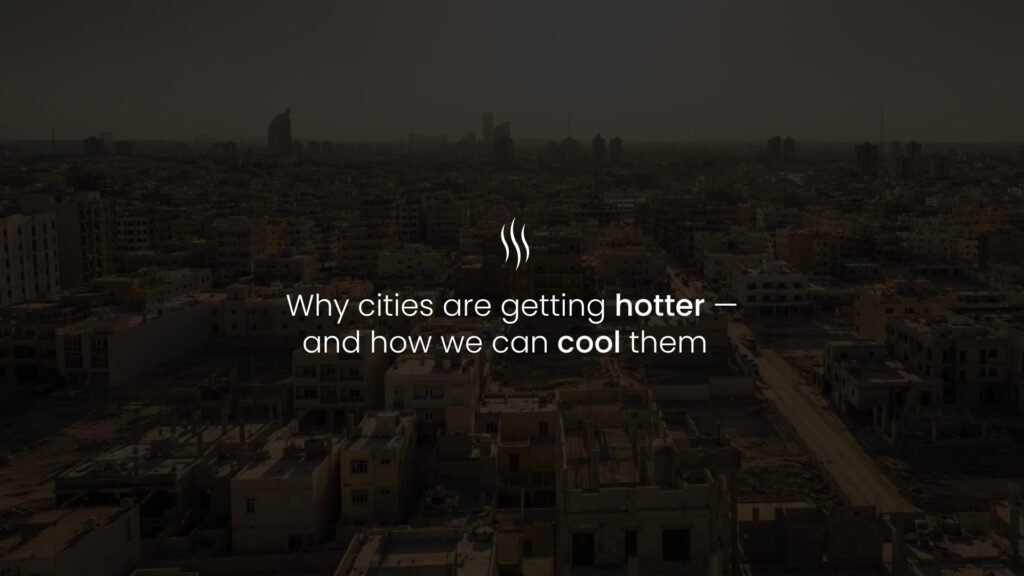
Urban Heat: Why Cities Are Getting Hotter and How We Can Cool Them
Cities are getting hotter.
Part of that is driven by a warming climate. But the way cities are built can make heat worse.
Concrete, asphalt, roofs and other hard surfaces absorb and retain solar energy. At the same time, urban development can replace vegetation and natural surfaces that provide shade and moisture.
The result is the Urban Heat Island (UHI) effect: built-up areas can become warmer than surrounding less-developed areas.
The U.S. Environmental Protection Agency identifies changes in land cover, urban materials, reduced vegetation and the physical structure of cities as important factors in the development of heat islands.
As extreme heat becomes a growing urban challenge, cooling can no longer be treated simply as an air-conditioning problem.
It is becoming a design problem.
The question is not only how to make cities greener.
It is how to design cities that can perform better in a hotter climate.
What Is the Urban Heat Island Effect?
The Urban Heat Island effect occurs when urbanized areas become warmer than surrounding rural or less-developed areas.
Several factors contribute to it.
Roofs, roads, sidewalks, parking areas and other built surfaces can absorb solar radiation and release stored heat over time. The properties of urban materials, including how they reflect, absorb and emit heat, also influence urban temperatures.
Building form can affect shade and airflow, while vehicles, air-conditioning systems and other urban activities can add heat.
At the same time, cities often have less vegetation and fewer natural surfaces.
According to the EPA, the loss of vegetation reduces shade and moisture that would otherwise help keep urban areas cool.
The result can be an urban environment where heat persists beyond the hours of peak sunlight.
Why Urban Heat Matters
Urban heat is not simply a question of outdoor comfort.
Heat islands can contribute to higher peak electricity demand, increased air-conditioning costs, air pollution and heat-related health risks.
There is also an important energy relationship:
More heat → greater cooling demand → greater pressure on energy systems.
UNEP similarly identifies sustainable urban cooling as an increasingly important challenge as rising cooling demand places pressure on electricity systems and contributes to emissions.
Reducing urban heat can therefore become part of a broader strategy for improving thermal comfort, reducing cooling demand and strengthening urban resilience.
Why Cities Need More Than Air Conditioning
Air conditioning will remain essential in many hot climates.
But cooling buildings after the surrounding environment has already become extremely hot is only one part of the solution.
A more resilient approach starts earlier.
It starts with questions such as:
- Where does solar exposure accumulate?
- Where do people need shade?
- Where can vegetation provide meaningful cooling?
- How are streets and buildings oriented?
- Which surfaces absorb the most heat?
- Where can green infrastructure provide the greatest benefit?
- How can water be managed responsibly?
These are not only engineering questions.
They are also questions of urban planning, architecture and landscape design.
UNEP’s sustainable urban cooling approach similarly emphasizes holistic, low-carbon solutions rather than relying on mechanical cooling alone.
How Nature Helps Cool Cities
Vegetation has its own cooling mechanisms.
Trees and plants provide shade, while evapotranspiration releases water vapour into the atmosphere and contributes to cooling.
The EPA identifies trees and vegetation as important heat-island reduction measures, with cooling benefits coming from both shade and evapotranspiration.
But this does not mean that the answer is simply to plant more.
The more useful question is:
Where can vegetation provide the greatest environmental and social value?
A tree shading a pedestrian route can serve a very different purpose from one planted where people rarely walk.
Effective urban greening considers climate, species selection, water availability, soil conditions, solar exposure, maintenance and how people use the space.
The right greenery, in the right place, can be more valuable than greenery added without a strategy.
From Greenery to Green Infrastructure
This is where urban cooling starts to move beyond landscaping into infrastructure.
Green infrastructure can include:
- Trees and urban vegetation
- Green roofs
- Green walls
- Parks and planted public spaces
- Green corridors
- Vegetated streetscapes
- Other Nature-Based Solutions
The EPA identifies trees and vegetation and green roofs among established approaches for reducing heat-island effects.
UNEP also highlights the role of urban Nature-Based Solutions in helping cities adapt to extreme heat while delivering wider environmental and social benefits.
The important shift is this:
Nature is not simply something we add to cities.
Nature can become part of how cities function.
Green Roofs: Cooling From Above
Roofs are among the urban surfaces most exposed to solar radiation.
A green roof introduces vegetation and growing media onto the roof, creating a system that can provide shade and cooling through evapotranspiration.
The EPA identifies green roofs as a heat-island reduction strategy and notes that they can reduce roof-surface temperatures and contribute to cooling around buildings.
Depending on the design, green roofs can also provide other functions, including stormwater management, habitat and usable green space.
For dense urban areas, this creates an opportunity to turn an exposed surface into a multifunctional environmental asset.
Green Walls in Dense Urban Environments
Not every development has enough horizontal space for extensive planting.
Vertical greenery creates another opportunity to introduce living systems into dense environments.
Green walls can contribute to biophilic environments and become part of a broader green infrastructure strategy.
But they should not be treated as a universal answer to urban heat.
The better question is:
What role is the green wall expected to perform?
It might improve a building entrance, enhance a workplace, introduce vegetation into a constrained space or contribute to a wider environmental strategy.
The answer should determine the design.
Urban Cooling Is Not One-Size-Fits-All
There is no single intervention that can cool every city.
Performance depends on:
Climate · Urban density · Building form · Solar exposure · Vegetation · Water availability · Surface materials · Air movement · Human use · Maintenance
That is why urban cooling needs to be site-specific and evidence-based.
The EPA recommends combining heat-island strategies according to local conditions, while UNEP emphasizes integrated and locally appropriate Nature-Based Solutions.
Where Schaduf Comes In
At Schaduf, we bring together landscape architecture, green solutions and smart environmental technology to explore how nature and the built environment can work together.
Through our three areas of expertise, we approach the challenge from different scales — from landscape and urban design to living systems and resource management.
But the starting point is always the same:
Understand the environment before designing the intervention.
In Part 2, we move from understanding the problem to exploring seven practical strategies for cooling cities.
Designing Cities for a Hotter Future
Urban heat is changing the way we think about cities.
The most resilient response will not come from one product, one technology or one landscape intervention.
It will come from integrating urban design, landscape, vegetation, water management, materials, buildings and technology into a more complete approach to cooling.
Because a greener city is good.
A cooler, more resilient and better-designed city is better.